


A New Zealand origin story can make an ingredient compelling, but it can’t establish what’s in it or how it will perform in a finished food. If you’re comparing functional food ingredients NZ suppliers offer, treat provenance as one part of the assessment. Composition, relevant evidence and formulation suitability matter just as much.
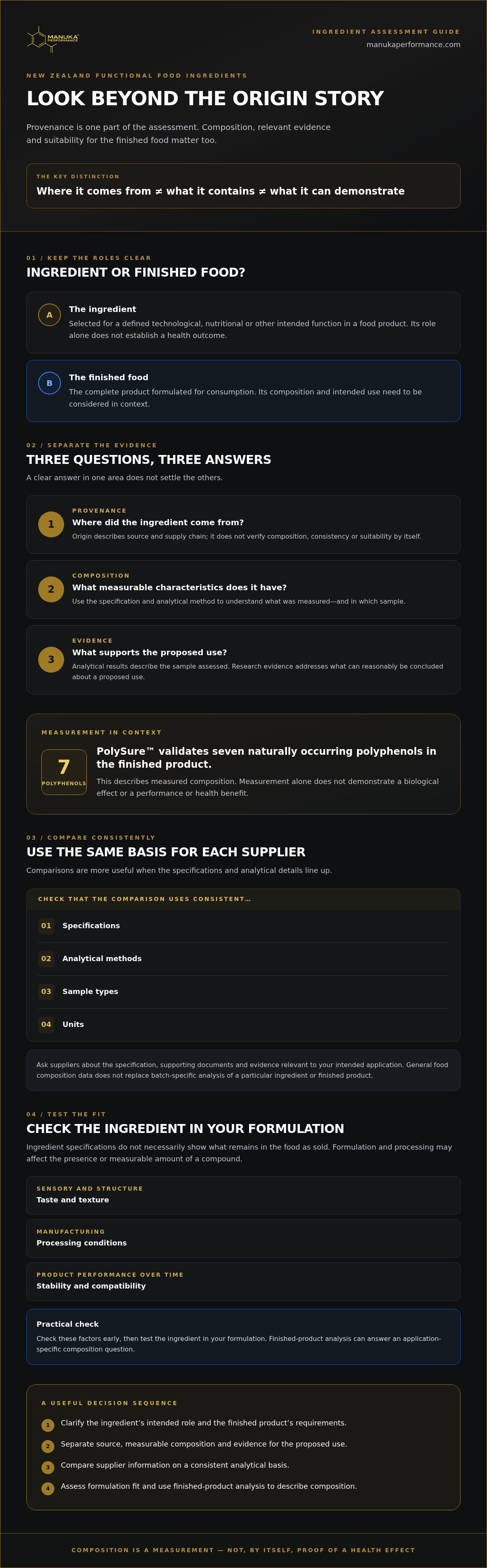
Ingredient claims can be difficult to compare, especially when natural origin is presented as a substitute for measurable information. This guide offers a practical way to assess an ingredient’s source, the compounds present and the evidence behind its proposed use. It also explains how to check whether an ingredient fits your product and processing requirements, and what to ask suppliers about specifications and supporting documents. PolySure™, for example, validates seven naturally occurring polyphenols in the finished product. That measurement describes composition, not a health effect.
Key Takeaways
- Separate an ingredient’s intended role in a food from the characteristics of the finished product before assessing its value.
- Compare functional food ingredients NZ suppliers offer using consistent specifications, analytical methods, sample types and units.
- Use a structured supplier review to clarify evidence, product requirements and the documentation available for your intended application.
- Check taste, texture, processing conditions, stability and compatibility early, then test the ingredient in your formulation.
- Use finished-product analysis to describe composition, while recognising that measurement alone doesn’t demonstrate a health effect.
What counts as a functional food ingredient in New Zealand?
A functional food ingredient is selected to provide a defined technological, nutritional or other intended function in a food product. It’s distinct from a finished functional food, which is the complete product formulated for consumption. An ingredient’s role alone doesn’t establish that the finished food delivers a particular health outcome.
The term can describe ingredients chosen for characteristics beyond basic formulation, but it shouldn’t be treated as proof of efficacy or as a substitute for assessing the product itself. The Functional food overview provides broader context for the term. For New Zealand product development, buyers still need to consider the ingredient, its use and the evidence supporting any proposed benefit.
How are functional ingredients different from ordinary food ingredients?
Many food ingredients have a practical role: oil can contribute richness, starch can influence thickness, and salt can affect flavour. An ingredient described as functional may also be selected for specified nutritional or bioactive characteristics, or for a technological purpose in the formulation. The distinction is about intended role and properties, not an automatic claim about health.
Interpretation depends on context. The finished product, amount used, preparation and intended use can all affect what an ingredient contributes. Traditional use or natural origin may provide useful background, but neither establishes the ingredient’s composition or proves a specific benefit. Those questions require relevant measurements and evidence for the proposed application.
What does New Zealand origin tell ingredient buyers?
New Zealand origin is a provenance attribute. It can identify where an ingredient comes from, but it doesn’t verify its composition, consistency or suitability by itself. Distinguish the source claim from information about the material, such as its specification and the method used to assess it.
New Zealand honey, for example, is used in some performance nutrition applications, including honey-based sports nutrition products. That doesn’t mean all honey from New Zealand shares the same profile or will behave identically in a formulation. Source, processing and finished-product context matter, so look for evidence relevant to the particular ingredient and intended use.
When assessing functional food ingredients NZ suppliers offer, keep three questions separate: where did the ingredient come from, what measurable characteristics does it have, and what evidence supports its proposed role? A clear answer to one doesn’t resolve the others.
How do provenance, composition and evidence shape ingredient value?
These are related but separate lines of evidence. Provenance identifies an ingredient’s source and supply chain. Composition describes what is present in a sample. Analytical methods explain how those components were assessed, while research evidence addresses what can reasonably be concluded about a proposed use. For buyers comparing functional food ingredients NZ suppliers offer, keeping these questions distinct prevents an attractive origin story or a single laboratory result from carrying more weight than it can support.
Polyphenols illustrate why precision matters. The term refers to a broad group of naturally occurring plant-derived compounds, not one uniform substance with a single profile or effect. Interpret a result for a specified polyphenol or defined set of compounds according to what was measured and in which sample. The New Zealand Food Composition Database can provide useful food composition context, but general food data doesn’t replace batch-specific analysis of a particular ingredient or finished product.
Why measure composition in the finished product?
An ingredient’s specification describes the ingredient tested. It doesn’t necessarily tell a product developer what remains in the food as sold. Formulation and processing may affect the presence or measurable amount of a compound, so finished-product analysis can answer a different, application-specific question. It can also make comparisons more meaningful when the analytical approach and compounds assessed are clearly defined.
PolySure™ is one example: its analytical standard validates seven naturally occurring polyphenols in the finished product. That information relates to measured composition. It doesn’t, by itself, establish a biological effect or demonstrate a performance or health benefit.
What can analytical results and research evidence establish?
Analytical results may help establish identity and quantity in the sample tested. Repeated measurements may also inform questions about consistency or stability under defined conditions. To judge how much weight a result can carry, ask for the method, sample type, units, detection limits and testing context. Check whether it applies to the raw ingredient, a production batch or the finished product, and whether independent verification is available.
Research evidence addresses a different question: whether an observed outcome is supported for the relevant material and intended use. Laboratory findings can help characterise a compound, but they shouldn’t be treated as proof of an outcome in people. Claims require evidence appropriate to the claim. Measured composition alone cannot establish efficacy, because the compounds measured, their amount, the formulation, exposure and study context don’t automatically demonstrate a meaningful biological response.
For a New Zealand example of measurement-led development, explore Mānuka Performance’s research-driven approach alongside the evidence and product documentation relevant to your own application.
How should New Zealand buyers compare functional food ingredients?
Compare candidates against the same product brief, not against broad supplier claims. The best-fit ingredient depends on the product’s purpose, target consumer, processing conditions and sensory requirements. A strong result in one category won’t necessarily make an ingredient suitable overall.
Compare provenance, specification, analytical method, evidence, formulation fit and supply documentation. Where possible, use the same sample type, units and intended application for each candidate.
| Criterion | What to compare |
|---|---|
| Provenance | Declared source, origin and relevant traceability information; distinguish source claims from proof of composition. |
| Specification | Ingredient identity, defined characteristics, composition and the basis of any stated limits or ranges. |
| Analytical method | Method, sample type, units and detection limits. Check that results for two candidates measure comparable properties. |
| Evidence | What the evidence actually covers, including the specific ingredient, formulation, amount and intended use. |
| Formulation fit | Performance in your product, including taste, texture, processing compatibility and stability. |
| Supply documentation | Current specifications, batch records and relevant safety, quality and traceability documents for the intended market. |
Which supplier documents should product developers request?
Request a current specification, confirmation of ingredient identity, composition data and relevant batch documentation. Ask for the analytical method and clarify whether each result applies to the raw material or a finished product. When comparing results, make sure the sample type and units align. A number without its measurement context can’t support a reliable like-for-like assessment.
Review available safety, quality and traceability documents against your product and intended market, and identify any gaps before formulation progresses. Requirements can depend on the ingredient and its use, so verify applicable New Zealand and Australia-New Zealand requirements with authoritative sources rather than assuming one supplier document answers every question.
How can buyers judge evidence without overclaiming?
Start by matching the evidence to the proposed use. Does it concern the same ingredient, formulation and amount, and is the study context relevant to the product you’re developing? Separate analytical characterisation, preclinical research and human studies in your evidence summary, because each addresses different questions. Record limitations plainly. An association or preliminary finding shouldn’t be presented as an established effect.
For functional food ingredients NZ buyers, a structured comparison turns supplier information into a product-specific assessment. It also makes uncertainty visible, helping teams decide what needs clarification or testing before selecting an ingredient.
What should New Zealand product developers check before formulation?
Move from the product brief to bench testing in a defined sequence. This keeps ingredient selection grounded in the product’s purpose and makes technical or compliance questions visible before they lead to reformulation.
- Define the product purpose. Describe the intended food, target consumer, use occasion and the ingredient’s role in the formulation.
- Check ingredient fit. Review its identity, composition and supplier specifications against the product’s sensory and manufacturing needs.
- Review the evidence. Confirm that available evidence relates to the ingredient, formulation and intended use, and record any limitations.
- Verify requirements. Check ingredient status, food category, composition and proposed statements against current New Zealand and Australia-New Zealand requirements.
- Test the formulation. Pilot the ingredient in the intended product and assess its performance under relevant processing and storage conditions.
How do processing and formulation affect ingredient suitability?
Ingredient data may not predict how a compound behaves after it is combined with other ingredients or exposed to processing. Consider whether heat, pH, storage conditions or other manufacturing steps could affect the measured compounds. Also assess taste, texture, colour and compatibility with the rest of the formulation. Don’t assume that a result in a supplier’s raw material specification describes the finished food.
Use product-specific pilot testing to examine those variables under conditions relevant to your process. This can reveal sensory changes, interactions or manufacturing constraints that aren’t apparent from ingredient data alone. Record the test conditions and measurements, so results can be interpreted against the product brief rather than treated as universal performance evidence.
Which New Zealand compliance questions need verification?
Before finalising a formulation, check whether the ingredient is appropriate for the intended food category, whether its composition and use meet applicable requirements, and whether proposed label statements are supportable. The relevant questions may depend on the product and market, so verify them against current guidance from New Zealand Food Safety and Food Standards Australia New Zealand (FSANZ), including the applicable Australia New Zealand Food Standards Code.
These checks aren’t legal conclusions. Classification, labelling and claims can require interpretation of product-specific details, so have qualified regulatory specialists review them before commercial release. For developers assessing functional food ingredients NZ options, this step connects formulation evidence with the requirements relevant to the finished product.
To explore a New Zealand example of research-driven product development, review Mānuka Performance’s research and biotech solutions.
How does Mānuka Performance apply measurement to New Zealand honey ingredients?
After assessing provenance, composition, evidence and formulation fit, it can be useful to see how a New Zealand company applies those principles. Mānuka Performance develops performance-led products and bioactive ingredients, including New Zealand honey-based sports nutrition products. Its work is an example of using measurement to characterise composition while keeping analytical information distinct from claims about outcomes.
What does PolySure™ measure in the finished product?
PolySure™ is an analytical standard that validates seven naturally occurring polyphenols in the finished product. Measuring the finished product provides composition information about the product in its formulated state, rather than relying solely on data about an ingredient before it is incorporated into a food.
For product developers, this kind of measurement can inform how specified compounds are characterised in a formulation and make composition discussions more precise. Interpret its scope carefully: validation of the seven polyphenols describes what the analytical standard addresses, but doesn’t, on its own, establish a health or performance outcome. Those conclusions require relevant evidence beyond a composition measurement.
That distinction matters when evaluating functional food ingredients NZ businesses develop or supply. Ask what was measured, whether the result relates to the ingredient or finished product, and how the information applies to the formulation you’re considering. Don’t extend a defined analytical result into a broader claim it wasn’t designed to support.
When might a research-led ingredient partnership be relevant?
A research-led approach may suit product developers seeking characterised bioactive ingredients or research and biotech solutions to inform product development. The fit depends on the project’s purpose, the ingredient’s documented scope, and the evidence and formulation requirements identified during selection. As with any supplier, review the supporting information and check whether it answers the questions specific to your intended product.
For further context, a useful area to explore is The Evolution of Sports Nutrition Biotechnology: From Synthetic Sugars to Bioactive Precision.
To explore Mānuka Performance’s bioactive ingredients and research-driven biotech solutions, review the company’s documented offerings and consider how their stated scope aligns with your product brief.
Make your next ingredient decision evidence-led
Choosing functional food ingredients NZ developers can use effectively means looking beyond origin or broad claims. Compare provenance, measurable composition and relevant evidence separately, then assess whether the ingredient suits your product’s purpose, processing conditions and sensory requirements.
Before formulation, verify the supplier documentation, applicable requirements and proposed product statements, then test the ingredient in the intended food. These steps help distinguish what is known about an ingredient from what still needs to be established for your finished product.
Mānuka Performance is a New Zealand functional nutrition company developing bioactive ingredients and research-driven biotech solutions. Its PolySure™ analytical standard validates seven naturally occurring polyphenols in the finished product, providing composition information without independently establishing a health or performance outcome.
Explore Mānuka Performance’s bioactive ingredients and research-driven solutions to discuss how the company’s documented offerings may fit your product brief.
Frequently Asked Questions
What is a functional food ingredient?
A functional food ingredient is selected to contribute a defined technological, nutritional or other intended function in a food. That role might relate to formulation properties or specified nutritional or bioactive characteristics. The term doesn’t, by itself, prove a health benefit. Assess the ingredient’s identity and composition, then consider how it’s used in the finished product, including its amount, preparation and intended purpose.
What are examples of functional food ingredients in New Zealand?
Examples depend on the intended product and the ingredient’s documented role. New Zealand honey is used in some performance nutrition applications, including honey-based sports energy products. Ingredients containing specified bioactive compounds, such as polyphenols, may also be selected for food formulations. Mānuka Performance develops New Zealand honey-based sports nutrition products and bioactive ingredients. Assess the relevant specifications and evidence for each particular ingredient and application.
How do you assess the quality of a functional food ingredient?
Assess quality by reviewing the ingredient’s identity, current specification, composition data, batch documentation and evidence relevant to its intended use. Check how results were measured, including sample type, method, units and detection limits, and confirm whether data describe the raw ingredient or finished product. Then evaluate safety and traceability documentation, sensory properties, processing compatibility and stability in your own formulation. Quality is application-specific, not just a supplier claim.
Does New Zealand origin mean an ingredient is more effective?
No. New Zealand origin provides information about provenance, but it doesn’t establish that an ingredient is more effective, compositionally consistent or suitable for a particular product. Those questions require evidence about the specific material, its measured characteristics and the intended use. Ask suppliers to distinguish origin documentation from batch specifications and analytical results, then assess any proposed benefit against relevant evidence rather than inferring it from geography alone.
What is the difference between a bioactive ingredient and a health claim?
A bioactive ingredient is characterised by one or more compounds or properties of interest in a food context. A health claim is a statement that links a food or component with a health effect, and it requires separate assessment against applicable requirements and supporting evidence. Identifying or quantifying a bioactive compound doesn’t automatically substantiate a health claim. Have proposed claims and labelling reviewed against current New Zealand and Australia-New Zealand guidance.
How can I verify polyphenol content in a food product?
Request analytical documentation that identifies which polyphenols were assessed, the sample tested, the method, units and relevant detection limits. Confirm whether the result refers to the ingredient or the finished product, and whether testing applies to the batch you’re evaluating. PolySure™ is an example of an analytical standard that validates seven naturally occurring polyphenols in the finished product. This characterises composition; it doesn’t independently demonstrate a health or performance outcome.
Can functional food ingredients be used in sports nutrition products?
Yes, an ingredient can be considered for a sports nutrition product if its role, composition and formulation suitability are established for that application. Assess taste, texture, processing conditions, stability and compatibility, then pilot-test the ingredient in the finished product. Also verify ingredient status, product classification, labelling and any proposed statements against current requirements. Mānuka Performance develops honey-based sports nutrition products designed to provide carbohydrate fuel.